 By
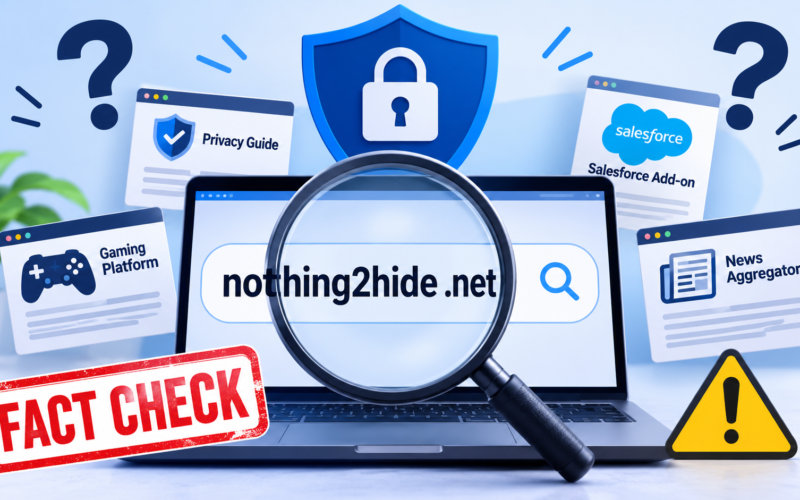
Search for nothing2hide .net and you will find a strange mix of results: a privacy guide, a gaming platform, a Salesforce add-on, and a news aggregator. They can’t all be describing the same thing. This post sorts out what can be verified, what looks invented, and where to find the actual organization behind the name. It was checked against public sources in November 2026.
Quick Answer: What Can You Confirm About Nothing2Hide .net?
Short version:
- The organization is real. Nothing2Hide (often shortened to N2H) is a French association. It is described as an association that gives journalists, lawyers, human rights activists and ordinary citizens technical solutions and training to protect their data and communications.
- Its materials point to a .org address. A resource list that links to its digital protection wiki and training page uses nothing2hide.org, not a .net domain.
- I could not verify what nothing2hide .net hosts. I found no reliable source identifying who operates it or what it publishes. Anyone who tells you otherwise with confidence is probably guessing.
- Many pages ranking for the term look auto-generated. They contradict each other on basic facts, including what the site does.
If you only need the takeaway, that’s it. The sections below show the evidence and give you a method for checking this kind of claim yourself.
Who Is Nothing2Hide? The Real Organization
Mission and Background
According to a profile from the Global Investigative Journalism Network (GIJN), the association was started by a group of journalists and former NGO workers to help journalists protect their data and communications. Its own description of its mandate lists journalists, bloggers, lawyers, whistleblowers and human rights defenders as the people it exists to help.
The co-founder and president is named publicly. A joint press freedom statement lists Grégoire Pouget as president and co-founder of Nothing2Hide (France). A named, findable person is one of the first things missing from the pages that rank for nothing2hide .net.
Services
A directory entry for the association lists the following offerings:
training, awareness campaigns, professional networks, workshops, and monitoring and reporting. A separate listing from the Open Technology Fund adds that the group provides capacity building and security assistance to civil society activists, human rights defenders and journalists worldwide, and can help with organizational and digital security support and with censorship events and network shutdowns.
| Service | Who it is for | What it involves |
|---|---|---|
| Training and workshops | Journalists, activists, citizens | Hands-on sessions on protecting information and communications |
| Awareness campaigns | General public | Explaining digital risks in non-technical terms |
| Professional networks | Media and rights organizations | Connecting people who face similar threats |
| Monitoring and reporting | Civil society groups | Tracking and documenting digital threats |
| Rapid security support | At-risk organizations | Help during censorship events and network shutdowns |
Reach and Credibility
A mirror of the organization’s about page says that since its creation in 2017 it has trained over 2,000 journalists, activists and citizens in 20 countries. Treat this as the organization’s own claim. It is consistent with other independent mentions, such as signatory lists on open letters from RSF and other press freedom groups, which include Nothing2Hide alongside established names.
One lesson from the group’s own writing is worth noting. In a GIJN article, the team said it learned that changing journalists’ habits is the fastest route to failure, so it avoided overhauling how people work. That is practical, specific advice, and it is the opposite of the vague slogans on the auto-generated pages.
Why Search Results for Nothing2Hide .net Contradict Each Other
Three Incompatible Identities
When a domain or brand name has little reliable coverage, low-effort content farms fill the gap. They write about the keyword without knowing anything about it. Here are the three identities that show up:
| Claimed identity | What the page says | Red flags |
|---|---|---|
| Privacy and security guide | A guide to privacy, security and digital freedom with articles, videos and infographics | No named author, no specific guide titles, vague testimonials |
| Gaming platform | An online gaming site built around transparency and community | Includes a “bio data” table naming a founder as “John Doe” and a 2021 founding date |
| Salesforce add-on | A privacy layer for Salesforce CRM with field-level encryption | No vendor, pricing, documentation, or customer names |
| News aggregator | A page about collecting the latest news from the site | Describes the concept of news coverage without a single dated headline |
A privacy nonprofit, a game studio, and an enterprise software vendor do not share one name by coincidence. The simplest explanation is that the pages are generated from the keyword itself, with the topic guessed from whatever words sit next to it.
Warning Signs of Auto-Generated Pages
Use this list on any page that makes big claims about a website you can’t otherwise verify:
- Generic benefits. Phrases like “invaluable resource” or “must-have” with no feature named.
- Fake specificity. A “bio data” box, founding year, or founder name with no source.
- Testimonials with initials only. One example credits a rescue from a phishing scam to a reviewer identified only as “Emily R.”
- No outbound links. Real reporting links to primary sources.
- Mismatched hosting. A page about a privacy site that lives on a game studio’s subdomain, a UK design firm’s FTP host, or an unrelated university news server.
- Keyword stuffing. The target phrase appears in nearly every sentence.
- No dates. Content about “latest news” with no dates or named events.
Nothing2Hide .net vs Nothing2Hide.org: Which Should You Trust?
What the Evidence Points To
Based on what I could find, the organization’s documented web presence uses nothing2hide.org. Its protection wiki, training page, and blog posts are linked at that address in other groups’ resource lists. That list includes a 2024 post on basic online protection tips for crisis situations on the .org site.
I found no credible source tying the .net address to the organization. That absence does not prove the domain is unrelated. It could be a redirect, an old domain, or a typo variation. It means you should not assume it is official.
Here is how I would treat each possibility:
| Scenario | What it means | What to do |
|---|---|---|
| .net redirects to the .org site | Probably owned by the organization | Bookmark the final .org address |
| .net hosts its own content | Unknown operator | Verify before sharing any personal data |
| .net is parked or for sale | No content | Ignore it |
| .net is a third-party article site | Not the organization | Treat claims about features with caution |
How to Check Any Privacy Site Yourself
Privacy sites are exactly where you should be careful about trust. Follow these steps:
- Look up the domain registration. A WHOIS lookup shows the registration date and, sometimes, the registrant. Many legitimate organizations use privacy protection, so a hidden name is not proof of anything, but a registration date from last month is a warning for a site claiming years of history.
- Find named people. An organization that trains journalists should have identifiable staff, board members, or founders.
- Cross-check with independent sources. Search for the organization on press freedom sites, funders’ directories, and network membership lists.
- Read the About page for specifics. Look for founding year, legal status, funding sources, and locations.
- Check the contact method. Real organizations publish ways to reach them that do not depend on a form alone.
- Look at what the site asks of you. A site that wants account details, payment, or downloads before showing any content deserves extra scrutiny.
The “Nothing to Hide” Argument, Explained
The brand name plays on a familiar phrase. Many US readers arrive at this topic because they have heard someone say they have nothing to hide, so they do not care about privacy. It’s worth addressing directly.
Why the Argument Fails
Privacy is not mainly about concealing wrongdoing. It is about control over who knows what about you, and what they can do with it. The legal scholar Daniel Solove made this point in his well-known essay on the topic: the argument assumes privacy is only about hiding bad things, which misses most of what privacy protects.
Practical reasons the argument breaks down:
- Context changes meaning. A medical visit, a search query, or a late-night location ping is harmless in one setting and damaging in another.
- Data is permanent and combinable. Information collected for one purpose gets reused for others, and small facts combine into detailed profiles.
- Errors happen. Records can be wrong, and the people harmed are often the ones with no way to correct them.
- Rules change. Something legal and ordinary today can become sensitive under a different law or a different government.
- Some people face higher risk. Journalists, lawyers, and rights defenders are the exact audience Nothing2Hide was built for, because exposure can put sources and clients in danger.
The US Legal Context
For US readers, the relevant background includes the Fourth Amendment and the third-party doctrine, which has historically limited privacy protection for information shared with companies. The Supreme Court narrowed that gap in Carpenter v. United States (2018), holding that police generally need a warrant to obtain historical cell-site location records. Many other kinds of data held by third parties remain less clearly protected, and the rules vary by state. If your situation involves legal risk, talk to a qualified lawyer rather than relying on a blog post.
A Practical Digital Security Checklist for US Readers
You do not need to be a journalist to use sound basics. The approach below follows the habit-first principle mentioned earlier: make a few changes you will actually keep.
Start Here
| Action | Why it matters | Effort |
|---|---|---|
| Use a password manager | Unique passwords stop one breach from spreading to other accounts | Low |
| Turn on multi-factor authentication | Blocks most account takeovers that start with a stolen password | Low |
| Prefer app-based or hardware keys over SMS codes | Text messages can be intercepted or hijacked through SIM swapping | Medium |
| Install system and app updates | Updates close known security holes | Low |
| Encrypt your devices | Protects data if a phone or laptop is lost or stolen | Low |
| Review app permissions | Many apps collect more than they need | Medium |
| Use an end-to-end encrypted messenger for sensitive talks | Protects message content in transit | Low |
Adjust for Your Risk Level
Not everyone needs the same setup. Ask three questions:
- What am I protecting? Financial accounts, health data, sources, client files, or your location.
- Who might want it? Scammers, an ex-partner, an employer, a data broker, or a government.
- What happens if it leaks? Embarrassment, fraud, job loss, or physical danger.
The answers decide how far to go. A person worried about scams needs strong passwords and multi-factor authentication. A reporter protecting a source needs a more careful setup and probably training from an organization like the one discussed above.
How to Cite or Link to the Organization Correctly
If you write about this topic, a few habits keep you accurate:
- Link to the organization’s own site and use independent coverage for outside claims, such as GIJN or OTF listings.
- Describe it as a French association focused on digital security for journalists and civil society, and avoid adding features you cannot source.
- Do not repeat claims from pages that cannot be verified. If a source describes nothing2hide .net as a gaming platform or a Salesforce tool, that claim is unsupported.
- State what you could not confirm. Saying “I could not verify who operates this domain” is more useful than a confident guess.
- Add a date. Domain ownership and site content change, so note when you checked.
Key Takeaways
- Nothing2Hide is a real French association that trains journalists, activists, and citizens to protect data and communications.
- Its documented web presence is at nothing2hide.org.
- Nothing2hide .net is not clearly tied to the organization, and no reliable source I found explains what it hosts.
- Pages claiming the term refers to a gaming site, a Salesforce product, or a news hub contradict each other and show common signs of auto-generated content.
- The phrase “nothing to hide” is a weak argument against privacy, and good digital security starts with a few durable habits.
Frequently Asked Questions
Is nothing2hide .net the official website of Nothing2Hide?
I found no reliable source confirming that. The organization’s materials point to nothing2hide.org, so use that address unless you can verify otherwise.
Who runs nothing2hide .net?
I could not confirm an operator. A WHOIS lookup and a check of the site’s About page are the best first steps.
Is nothing2hide .net a gaming platform?
Some pages claim so, but they contain fabricated-looking details like a “John Doe” founder. No credible source supports it.
Is nothing2hide .net connected to Salesforce?
No reliable evidence supports that. The pages making this claim name no vendor, pricing, or documentation.
What does the real Nothing2Hide organization do?
It provides training, workshops, awareness campaigns, and security assistance to journalists, activists, and citizens. It is based in France and works internationally.
Where is Nothing2Hide based?
It is a French association. It is listed under France in GIJN’s directory of member organizations.
Is it safe to enter personal information on nothing2hide .net?
Do not, unless you have verified who operates the site. For a site that claims to teach privacy, be especially careful with accounts, downloads, and payments.
Why do search results show so many different descriptions?
Content farms generate pages around keywords without verifying facts, so each one invents a different identity.
Does having nothing to hide mean privacy does not matter?
No. Privacy is about control over information and its use, not only about concealing wrongdoing.
What is the first step to improve my digital security?
Set up a password manager and turn on multi-factor authentication. Those two changes block a large share of common account takeovers.
